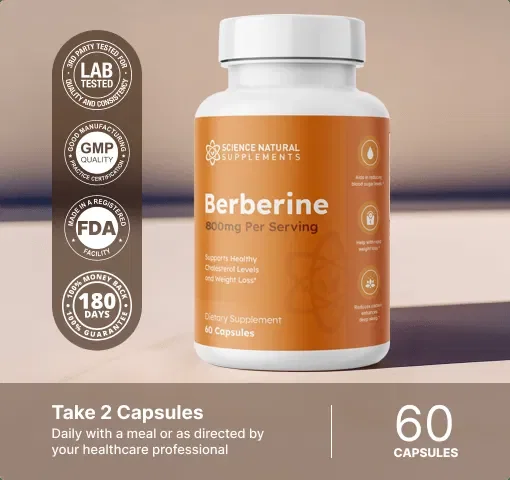
What Is Berberine, Exactly?
Berberine is a naturally occurring plant alkaloid, meaning it’s one of those nitrogen-containing compounds that plants produce and that happen to have powerful effects on the human body — think of it as a distant chemical cousin to caffeine and morphine, even though it behaves nothing like either.
You’ll find it in barberry, goldenseal, Oregon grape, and tree turmeric, plants that give off that unmistakable bright yellow color and bitter taste whenever they’re processed.
It’s been a staple in traditional Chinese medicine for more than 400 years, historically used to treat diarrhea and other gastrointestinal infections, long before anyone was studying its effects on blood sugar or cholesterol in a lab.
Ayurvedic practitioners in India used related berberine-containing plants for similar digestive and anti-inflammatory purposes, so this isn’t some overnight TikTok discovery — it’s an old-world remedy that modern researchers only recently started taking seriously.
What’s changed is the science: researchers have found berberine may help with type 2 diabetes, high cholesterol, obesity, polycystic ovarian-related metabolic conditions, inflammation, and gut health, though the strength of evidence varies quite a bit by condition.
That’s the honest starting point — a genuinely interesting compound with a long history, now getting the randomized-trial treatment it never had before, and the results so far are promising enough to explain why it’s suddenly everywhere.
Important notice: This content is for informational purposes and is based on an analysis of scientific studies and public information regarding the ingredients. It is not a substitute for medical advice. Results vary from person to person.
If you have pre-existing health conditions or are taking medication, consult your doctor before starting any supplementation.
- What Is Berberine, Exactly?
- How Berberine Works Inside Your Body
- Top Science-Backed Benefits of Berberine
- Berberine vs. Metformin: What’s the Real Difference?
- How Much Berberine Should You Take?
- Side Effects and Safety Concerns
- How to Choose a Quality Berberine Supplement
- Berberine and Long-Term Use: What the Research Says
- Conclusion
- Frequently Asked Questions
How Berberine Works Inside Your Body
Berberine isn’t a one-trick supplement. It doesn’t just nudge one hormone or block one receptor — it works through several overlapping pathways at once, which is part of why researchers get excited about it and part of why it can interact with so many medications.
Think of your metabolism as a massive control room with dozens of switches and dials, and berberine walks in and starts flipping several of them simultaneously.
That’s unusual for a plant compound, and it’s the reason scientists keep comparing it to actual pharmaceutical drugs rather than to your average herbal supplement.
Activating Your Metabolic Master Switch (AMPK)
The centerpiece of berberine’s mechanism is an enzyme called AMPK, short for AMP-activated protein kinase, which functions almost like your cells’ energy thermostat.
When AMPK gets switched on, your cells shift into a mode that favors burning stored energy over stockpiling it, which helps explain berberine’s effects on both blood sugar and fat metabolism.
Interestingly, this is the exact same switch that metformin — the most widely prescribed diabetes drug on the planet — also flips, just through a slightly different chemical route involving mitochondrial complex I.
Berberine’s activation of AMPK reduces how much glucose your liver pumps out into your bloodstream, which is a big part of why fasting blood sugar tends to drop in people who take it consistently.
It also shifts how your body handles fat, favoring oxidation (burning) over storage, which ties directly into the cholesterol and weight-related benefits people report.
This shared mechanism with metformin isn’t a coincidence researchers stumbled on by accident — it’s exactly why the two compounds get studied head-to-head so often, and why so many people ask whether berberine could stand in as a natural alternative.
Berberine’s Role in Gut Health
Here’s where berberine does something metformin simply can’t replicate: it reshapes your gut microbiome in ways that seem to independently support metabolic health.
Research shows berberine may help balance intestinal health by reducing harmful bacteria while encouraging the growth of beneficial strains, and this gut-level shift appears to contribute to its lipid-lowering effects separately from the AMPK pathway.
Your gut bacteria play a surprisingly large role in how you process cholesterol, regulate inflammation, and even manage insulin sensitivity, so a compound that can nudge that ecosystem in a healthier direction has ripple effects well beyond digestion.
This dual action — hitting AMPK in your cells while also reshaping your microbiome — is part of why some researchers think berberine might eventually prove useful for conditions where metformin alone falls short.
It’s also a big reason berberine tends to cause digestive symptoms when people first start taking it, since you’re essentially renovating the bacterial population living in your intestines, and renovations are rarely quiet or comfortable at first.
Top Science-Backed Benefits of Berberine
So what does all that mechanism actually translate to in real life? Three benefit categories keep showing up across the clinical literature: blood sugar control, cholesterol improvement, and modest weight management support.
None of these are miracle claims, and the quality of evidence varies by category, but there’s enough consistency across independent trials to take berberine seriously as a metabolic-support supplement rather than dismiss it as wellness-industry noise.
Blood Sugar and Insulin Sensitivity
This is berberine’s best-documented benefit by a wide margin.
A review of more than 46 clinical trials covering over 2,000 participants found that, on average, berberine lowered fasting blood sugar by roughly 0.89 mmol/L and produced meaningful reductions in HbA1c, the marker doctors use to track three-month blood sugar averages.
What makes this notable is that these aren’t tiny, underpowered studies — they’re a substantial body of evidence pointing in the same direction.
In one trial, participants saw hemoglobin A1c drop from 9.5 to 7.5 and fasting blood glucose fall from 10.6 to 6.9 mmol/L over three months of berberine use, results that wouldn’t look out of place in a pharmaceutical trial.
The catch is that most of this research has been conducted on smaller samples, largely within Chinese populations, so scientists are still calling for broader, more diverse, longer-duration studies before treating these numbers as universally applicable.
Still, if you’re someone dealing with borderline blood sugar or early insulin resistance, this is the benefit category with the sturdiest scientific floor underneath it.
Cholesterol and Cardiovascular Support
Berberine’s lipid-lowering effects might actually be its most underrated benefit, since most of the public conversation fixates on blood sugar and weight.
In one clinical trial, 500 mg of berberine taken twice daily produced significant reductions in total cholesterol, triglycerides, and LDL cholesterol among hyperlipidemic patients compared to a placebo group over 12 weeks.
Broader research on heart health also shows berberine can raise HDL — the “good” cholesterol — while simultaneously lowering total cholesterol, LDL, and triglycerides, a combination that’s genuinely hard to pull off with lifestyle changes alone.
There’s also promising data on blood pressure and heart rhythm:
studies indicate that combining berberine with hypertension medication lowered blood pressure more effectively than medication used alone,
and taking berberine alongside standard heart disease treatments has been shown to ease fatigue and irregular heartbeat symptoms, lowering the chance of death without notable added side effects.
Cleveland Clinic functional medicine specialist Dr. Layth Tumah put it plainly when discussing natural supplements like this one:
“People are starting to look at more natural approaches and treatments,” though he’s quick to add that berberine’s effects run closer to medication than to a typical herbal remedy — which is exactly why the cardiovascular data here deserves more attention than it usually gets.
Weight Management and Fat Metabolism
Weight loss is where the “nature’s Ozempic” comparison gets stretched thinner than the evidence can support.
A review of 18 studies found that people who took more than 1 gram of berberine daily for eight weeks or longer did tend to lose weight, which sounds encouraging until you dig into the fine print.
Many of these weight-loss studies are considered low quality with a fairly high risk of bias, meaning there’s currently no strong medical consensus on exactly how effective berberine is for shedding pounds, and new, higher-quality research is still needed to settle the question.
As for the Ozempic comparison specifically, while some people do call berberine “nature’s Ozempic,” that framing may be exaggerated, since the two compounds work through entirely different mechanisms — Ozempic slows digestion, while berberine influences how your body breaks down and uses energy.
Semaglutide drugs like Ozempic have gone through rigorous FDA approval specifically for weight loss with robust trial data behind them; berberine hasn’t, and realistically shouldn’t be marketed as an equivalent.
If you’re hoping berberine alone will produce dramatic weight loss, temper those expectations — think modest metabolic support layered on top of diet and exercise, not a substitute for either.
Berberine vs. Metformin: What’s the Real Difference?
This comparison comes up constantly, and for good reason — both compounds hit the same AMPK pathway and both get used for blood sugar management.
One of the most cited head-to-head trials, led by Yin and colleagues, randomized 116 patients with type 2 diabetes to either berberine 500 mg three times daily or metformin 500 mg three times daily for three months.
The results were strikingly close: berberine reduced HbA1c by 2.0 percentage points compared to metformin’s 2.01, with fasting blood glucose dropping by around 26.7% in the berberine group.
A later meta-analysis pooling data from 28 randomized controlled trials involving more than 2,500 patients found that berberine reduced HbA1c, fasting glucose, and post-meal glucose comparably to standard oral diabetes drugs, including metformin, with fairly consistent effect sizes across studies.
Where the two really diverge is track record and speed. Metformin typically produces its full effect within about 4 to 5 days, while berberine tends to take around three months to reach comparable results — a meaningful difference if you need fast blood sugar control.
Metformin also carries six decades of clinical use, FDA approval, and documented cardiovascular outcome data that berberine simply hasn’t accumulated yet,
which is why doctors continue to view them as differing mainly in research depth, regulatory status, and side-effect profiles rather than in raw glucose-lowering power.
Nobody serious is suggesting you drop a prescribed medication for a supplement — but for people who are prediabetic, intolerant of metformin’s GI side effects, or simply without prescription access, the comparative data on berberine is more legitimate than most people assume.
| Feature | Berberine | Metformin |
|---|---|---|
| Regulatory status | Dietary supplement, not FDA-approved for any condition | FDA-approved prescription medication |
| Typical onset | Around 3 months for full effect | 4–5 days for full effect |
| Blood sugar evidence | Comparable to metformin in short head-to-head trials | Extensive, decades of large-scale trial data |
| Lipid effects | Notable LDL/triglyceride reduction, some HDL increase | Modest lipid effects, not a primary benefit |
| Common side effects | GI upset (diarrhea, cramping) in early weeks | GI upset, vitamin B12 depletion long-term |
| Long-term safety data | Limited — mostly 8–12 week to 6-month trials | Extensive, decades of real-world use |
| Cost | Generally lower, varies widely by brand quality | Low-cost generic, insurance-covered in many cases |
How Much Berberine Should You Take?
Dosage is where a lot of confusion creeps in, mostly because there’s no single regulatory body setting an official recommended dose the way there is for, say, vitamin D.
There aren’t official dosage guidelines for berberine, but most clinical studies have used anywhere from 500 mg to 1,500 mg per day, which gives you a reasonably wide but still bounded range to work with rather than a total free-for-all.
Standard Dosage Guidelines
Many studies use a typical dosage of 500 mg taken two to three times per day, which lands most people somewhere between 1,000 and 1,500 mg total daily — the range that shows up again and again in glucose and lipid research.
Examine.com’s analysis puts the standard dose slightly higher, at 900 to 2,000 mg per day divided into three to four doses, reflecting the fact that different studies tested different amounts depending on the condition being targeted.
Berberine is generally considered safe for most people at dosages up to 1,500 mg per day, and going meaningfully beyond that range doesn’t appear to add much extra benefit while it does raise the odds of digestive discomfort and, in rare cases, liver enzyme changes.
If you’re brand new to berberine, starting at the low end and working upward gives your gut time to adjust rather than throwing your whole system into disarray on day one.
Because it has a fairly short half-life in the body, splitting the total dose across two or three separate servings tends to keep blood levels more stable than taking it all at once.
Best Time and Way to Take It
The best time to take berberine is before a meal — especially larger meals or ones high in carbohydrates — because this timing maximizes its effect on blood sugar and metabolism.
Most people split their daily total into two or three doses, taking each dose roughly 10 to 15 minutes before eating, which lines up with when your blood sugar is about to spike and gives berberine’s AMPK-activating effect a chance to blunt that rise in real time.
Newer extended-release and enhanced-absorption formats have made once-daily dosing of around 1,200 mg an increasingly convenient option for people who’d rather not remember three separate doses a day, though the traditional split-dose approach remains the more clinically studied method.
What actually matters more than nailing perfect timing is consistency — taking it reliably every single day matters more than optimizing to the minute,
since most studies evaluate berberine’s effects over 8 to 12 weeks of daily use, meaning visible results build gradually rather than showing up overnight.
If your schedule makes three daily doses unrealistic, a once-daily enhanced-absorption product is a perfectly reasonable trade-off for staying consistent.
Side Effects and Safety Concerns
Berberine gets marketed as gentle and natural, but its side effect and interaction profile is closer to what you’d expect from an actual pharmaceutical than from a typical vitamin.
That doesn’t mean it’s dangerous for most healthy adults — it just means it deserves the same respect you’d give any compound that meaningfully alters liver enzyme activity and blood sugar levels.
Common Digestive Issues
GI side effects — diarrhea, nausea, and cramping — are the most common complaints, affecting somewhere between 10% and 35% of users depending on the dose, and they usually resolve within one to two weeks.
Berberine causes gastrointestinal side effects in roughly 20-30% of users, particularly during the initial weeks of use, which tracks with the idea that your gut microbiome needs a short adjustment period as berberine starts reshaping the bacterial population living there.
Mild to moderate constipation showed up in 3-8% of subjects across clinical studies, and no severe adverse effects or significant changes to kidney and liver parameters were observed even at doses up to 1,500 mg daily for three months.
Skin reactions are rarer but documented — if you develop a rash or unusual itching after starting berberine, that’s a signal to stop and check in with a healthcare provider rather than push through it.
The practical takeaway is simple: start at a lower dose, give your body a couple of weeks to adjust, and most people find the digestive symptoms fade well before they’ve reached the full clinically studied dose.
Drug Interactions You Need to Know
This is the section that matters most if you’re taking any prescription medication, and it’s frequently glossed over on supplement marketing pages.
Berberine inhibits cytochrome P450 enzymes — particularly CYP3A4 and CYP2D6 — which are responsible for metabolizing approximately half of all prescription medications, meaning it has the potential to interact with an enormous swath of common drugs, not just diabetes medications.
The strongest documented concern involves cyclosporine, a transplant medication with a notoriously narrow safety margin;
human evidence shows berberine can slow its breakdown and raise its blood levels, and a case report has also linked berberine to a sharp rise in tacrolimus levels, another transplant drug where small dosage shifts matter enormously.
Beyond transplant drugs, berberine’s enzyme inhibition creates real interaction risks with warfarin, statins, digoxin, and diabetes medications, and hypoglycemia becomes a genuine concern when it’s combined with metformin or sulfonylureas.
That said, the overall risk of a clinically significant interaction appears low for most people, with only one interaction rated as major and the majority classified as moderate, theoretical, or early-evidence concerns rather than confirmed dangers.
The bottom line isn’t “avoid berberine if you take any medication” — it’s “have an actual conversation with your doctor or pharmacist before combining it with anything else,” especially blood thinners, cholesterol drugs, or diabetes prescriptions.
How to Choose a Quality Berberine Supplement
Here’s the part almost nobody talks about, and it might be more important than dosage itself: a shocking number of berberine products on the market don’t actually contain what their label claims.
Label Red Flags and Green Flags
A recent round of independent testing by SuppCo found that more than half of 13 top-selling berberine products purchased on Amazon failed to achieve even 50% of the berberine potency claimed on the label, with several brands containing less than 10% of the stated amount.
Gummies performed the worst by far, with some containing no detectable berberine whatsoever, and products advertising the highest doses — 1,500 mg or more — were the most likely to fail testing altogether.
There’s also a pricing pattern worth knowing about: cheaper products, generally those under $25, were significantly more likely to fail potency testing than higher-priced options, though a higher price alone is obviously no guarantee of accuracy.
Part of the problem traces back to raw material quality rather than outright fraud —
a 2017 analysis published in Food Chemistry tested commercial berberine extracts and found purity levels ranging anywhere from under 50% to over 98%, meaning a “500 mg berberine” label could legally describe a capsule containing barely half that in actual active compound.
The fix is straightforward even if it takes a bit of label-reading:
look for brands that publish third-party lab verification confirming what’s on the label matches what’s actually in the bottle,
with no undisclosed contaminants like heavy metals, and favor products that clearly state “berberine HCl” with a specific purity percentage rather than a vague “berberine extract” listing.
Who Should Steer Clear of Berberine?
Berberine isn’t appropriate for everyone, and a few groups should avoid it entirely rather than just proceeding cautiously.
Berberine is contraindicated during pregnancy and breastfeeding — it crosses the placenta and has been linked to kernicterus, a serious form of newborn jaundice, making it unsafe for expecting or nursing mothers.
Children under 18 should never take berberine under any circumstances, and this isn’t a soft recommendation — pediatric safety data simply doesn’t exist for this compound.
People managing liver or kidney conditions also need to steer clear, since berberine might not be safe for adults who have liver or kidney problems given how heavily the compound is processed through the liver’s enzyme pathways.
Anyone taking cyclosporine, tacrolimus, or a heavy load of medications metabolized through CYP3A4 falls into a similarly high-caution category,
given the documented interaction risks covered earlier — this isn’t a supplement to casually stack onto a complex medication regimen without professional input.
And if you’re already on prescribed diabetes medication, don’t add berberine on your own initiative just because it sounds like a “natural boost”;
the combined blood-sugar-lowering effect can tip you into hypoglycemia, and that adjustment needs to happen under a doctor’s supervision, not through guesswork with a supplement bottle.
Berberine and Long-Term Use: What the Research Says
The honest gap in berberine’s story is duration — almost everything we know comes from relatively short trials.
Most liver injury cases associated with berberine involved people taking 2,000 mg or more daily, well above standard recommendations, and the overall hepatotoxicity risk appears low — probably less than 1 in 1,000 users based on currently available data.
Still, that risk profile is based mostly on studies running anywhere from eight weeks to about six months, which leaves genuine open questions about what happens after a year or more of continuous use.
Researchers haven’t stopped digging, either —
a University of Northern Colorado clinical trial examining berberine supplementation alongside sprint interval training and immune function wrapped up in mid-2026, part of a growing wave of studies looking beyond just blood sugar and cholesterol toward exercise performance and immune markers.
For context on how mainstream berberine has become outside the diabetes-and-cholesterol conversation,
the World Anti-Doping Agency’s 2026 list of prohibited substances doesn’t include berberine, which is a small but telling signal of how it’s currently classified relative to actual performance-enhancing compounds.
The reasonable stance for now is to treat berberine the way you’d treat any moderately potent supplement with a growing but still incomplete evidence base — genuinely useful for many people,
backed by real data on blood sugar and lipids, but not something to take indefinitely without periodic reassessment or a doctor checking in on your liver function if you’re using it long-term.
Conclusion
Berberine earns its reputation as one of the more legitimately interesting supplements on the market right now —
the blood sugar and cholesterol research is real, the AMPK mechanism is well-documented, and the head-to-head data against metformin is more compelling than most people expect from a plant compound.
That said, it’s not a miracle weight-loss shortcut, it’s not risk-free if you’re on other medications, and it’s absolutely not immune to the supplement industry’s persistent quality-control problems.
Treat it the way you’d treat a mild-to-moderate strength medication: start low, watch how your body responds, buy from a brand that can prove what’s actually in the bottle, and loop in your doctor if you’re taking anything else.
Do that, and berberine has a genuinely solid shot at earning a permanent spot in your routine rather than becoming another abandoned bottle in the back of your cabinet.
Frequently Asked Questions
Is berberine really “nature’s Ozempic”?
Not quite. Berberine and Ozempic both influence blood sugar and weight, but through completely different mechanisms — Ozempic slows digestion via a GLP-1 pathway, while berberine works through AMPK activation and gut microbiome changes.
Ozempic also has robust FDA-approved weight-loss trial data behind it; berberine’s weight-loss evidence is comparatively thin and inconsistent.
How long does it take berberine to work?
Blood sugar and cholesterol changes typically start appearing within a few weeks, but most clinical trials measure meaningful results after 8 to 12 weeks of consistent daily use.
Unlike metformin, which can show effects within days, berberine tends to take closer to three months to reach its full impact.
Can I take berberine with metformin?
Some research has explored combining the two, but doing so raises the risk of hypoglycemia since both lower blood sugar through overlapping pathways. This combination should only be attempted under a doctor’s supervision with blood sugar monitoring, not on your own.
What’s the difference between berberine and berberine HCl?
Berberine HCl (hydrochloride) is simply the most stable, most studied, and most bioavailable salt form of berberine used in nearly all clinical research and quality supplements.
If a label just says “berberine extract” without specifying HCl and a purity percentage, treat that as a red flag rather than a green one.
Is berberine safe to take every day long-term?
For most healthy adults at standard doses (up to about 1,500 mg daily), current data suggests a reasonably good safety profile, with serious liver issues being rare and mostly linked to doses above 2,000 mg.
That said, most safety studies only run 8-12 weeks to six months, so periodic reassessment with a doctor — including liver function checks for extended use — is a sensible precaution rather than an overreaction.